 Jumie
How to make a monthly budget that works
A budget isn't about cutting everything you enjoy. It's deciding ahead of time where your money goes, instead of finding out afterwards where it went.
What a monthly budget is
A monthly budget is a simple plan: how much comes in, how much is already committed to fixed costs, and how much you allow yourself to spend in each variable category. It works as a ceiling, not a spending target.
Step by step
- Work out your monthly take-home pay. What actually lands in your account after taxes and deductions.
- List your fixed costs. Rent or mortgage, utilities, insurance, tuition, subscriptions and loan or card payments.
- Set aside what you want to save first. Treating savings like a bill is what makes it actually happen.
- Look at what went to variable spending last month. Groceries, eating out, transportation and leisure. If you don't have that number, track for a month before setting caps.
- Set a cap for each variable category. Fixed costs, savings and caps together can't add up to more than your income.
- Check in during the month, not just at the end. Knowing leisure hit 80% on the 15th gives you time to adjust.
The 50/30/20 rule as a starting point
If you don't know where to start, the 50/30/20 rule is a well-known split that's easy to remember:
- 50% for needs: housing, bills, groceries, transportation and health.
- 30% for wants: restaurants, leisure, shopping and travel.
- 20% for the future: an emergency fund, investing or paying down debt.
It's a guideline, not a law. In cities with high rent, needs can go over 50%. What matters is that the future slice exists, even if it starts small.
A worked example
For a take-home pay of $5,000, one possible budget looks like this:
| Category | Monthly cap |
|---|---|
| Housing and bills | $1,900 |
| Groceries | $700 |
| Transportation | $400 |
| Eating out | $450 |
| Leisure | $300 |
| Subscriptions | $100 |
| Other | $150 |
| Savings and investing | $1,000 |
How to keep track without the effort
A budget only works if you know, during the month, how much you've already spent in each category. With Jumie, you set the cap once, like “my grocery budget is $700 a month”. From then on, every expense you log by voice, text or photo counts toward the right category.
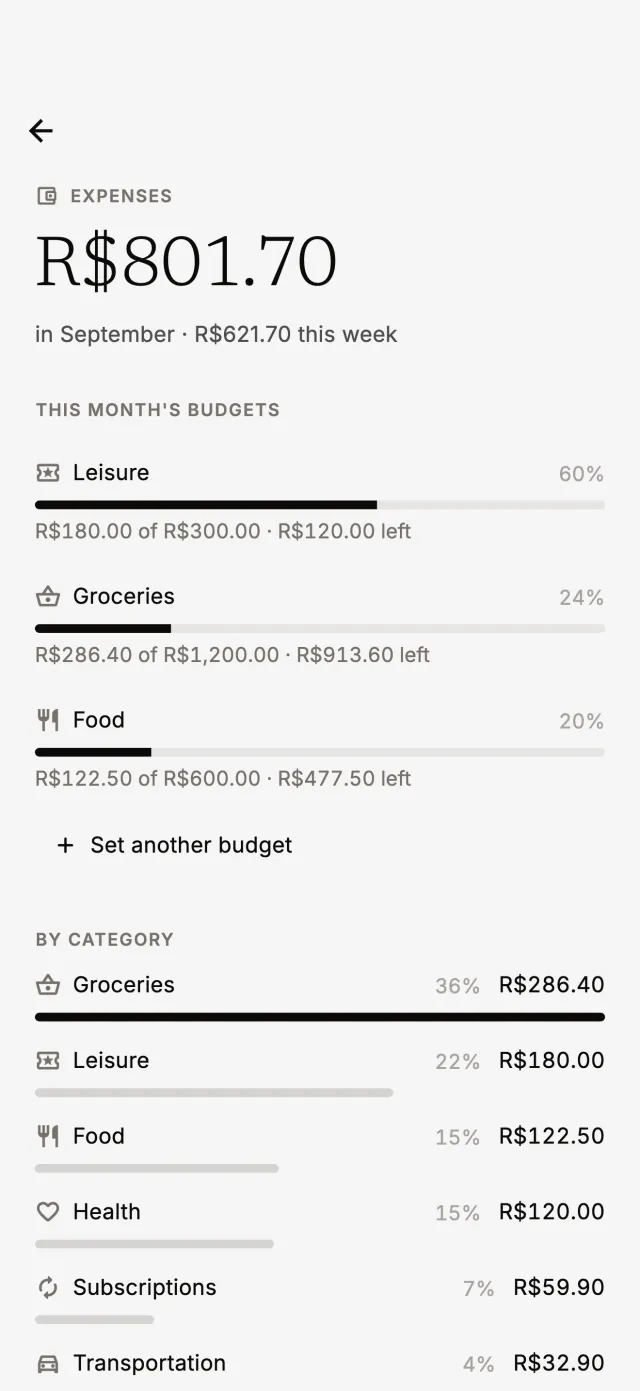
When a category passes 80% and 100% of its cap, you get a notification. You can also ask anytime: “how much can I still spend on leisure this month?”.
Common mistakes
- Unrealistic caps. Cutting leisure in half overnight usually lasts a week. Bring it down gradually.
- Forgetting yearly costs. Car registration, property tax, back-to-school and holiday gifts. Divide by 12 and set it aside every month.
- Not having an “Other” category. Something unexpected always comes up. Better to leave room for it.
- Giving up the first month you go over. The first month is for calibrating. Your budget gets better every cycle.
Don't know yet how much you spend per category? Start with the guide on how to track expenses without a spreadsheet.